
The Concerning Case of Oregon
Proponents of physician assisted suicide (PAS) often point to Oregon as an example of where PAS has worked well and been “virtually abuse-free.” Yet, the evidence from Oregon as reported by Oregon’s own state government suggests a number of reasons to be concerned about what happens when PAS is legalized.
A number and range of abuses actually have taken place in Oregon. If these take place even in a system that supposedly has strict rules and protections in place to prevent abuse, then this suggests that significant and varied abuses are an inevitable part of any system.
An elderly woman, Kate Cheny, died by PAS even though she had dementia and one physician described her daughter as “somewhat coercive.” Another psychiatrist found the elderly woman lacked competence to decide on her own death. Her daughter went “doctor shopping” until she found a doctor who was willing to prescribe a lethal dose of drugs. (3,4)
Several others, Wendy Melcher, Annie Jones, John Avery, and several other patients were euthanized by illegal overdoses of medications given them by a nurse. None of these cases were prosecuted. (3,6)
The cases of botched suicides give lie to the idea that PAS provides a peaceful and dignified death. One case described a man at home, without a doctor present. He took the lethal dose of drugs, has “physical symptoms… that were hard for his wife to handle.” She called 911 and he was taken to a hospital, then to a nursing facility, dying some time after that (4)
At least 30 patients in Oregon regurgitated some of the drugs, some suffering protracted deaths, others gaining consciousness and surviving. They did not choose to go through the process again (4).
PAS in many cases in not a free choice, people have been coerced into it or permitted to use it even if they are probably depressed and suicidal.
The case of Kate Cheny above is a particularly striking example, she had dementia, her daughter was described as coercive by at least one physician and was described by another as becoming angry when a psychiatrist found her mother not competent to choose PAS. The Kate Cheney accepted the Psychiatrists decision, but the daughter did not. The daughter then arranged for another consultation, which allowed the prescription of lethal drugs, giving them to the care of her daughter. After going to a nursing home for two weeks, Cheney’s daughter gave her the drugs, ostensibly at her request. (1,3,4).
From 1998 to 2012 an average of only 6.2% of patients who died of PAS in Oregon were referred to counseling for impaired judgment. By 2013 -2016, this declined to 4%.
One man, Michael Freeland, aged 64 had a long history of depression and suicide attempts. He was so prone to suicide that guns had been removed from his house, but a Compassion and Choices doctor gave him a lethal prescription because of it. Another Compassion and Choices doctor offered to sit with him while he took the drugs. In this case, however, anti-PAS doctors from Physicians for Compassionate Care Education Foundation (PCCEF), contacted him, improved his pain management with the result that he died comfortably and naturally several weeks later after reconciling with a daughter (6).
“Doctor shopping” eliminates many supposed safeguards in the law.
In practice a physician must believe that the patient is competent to request PAS. Unfortunately, most doctors will not order a psychological or psychiatric evaluation. If they do and the evaluation comes back negative, the patient or the family can “doctor-shop” for a more sympathetic doctor.
“Helen”, an 85 year old breast cancer patient, was the first women to receive PAS in Oregon found that her first two physicians would not aid her in her drive for PAS, the second because he believed he was depressed. Helen’s husband then contacted Compassion and Choices, a pro-euthanasia organization, that referred Helen to a doctor who prescribed the drugs despite the fact that Helen was neither bedridden nor in great pain. The prescribing physician later regretted that he did so on the basis of only a brief consultation with her. (1- p124)
Dr. Peter Goodwin, former medical director of Compassion and Choices (formerly called The Hemlock Society) estimated that the pro-PAS organization was involved in 75% of deaths from PAS in Oregon. This number later increased in 90%, before the group stopped providing this information. Nonetheless, this suggests that people are contacting the group hoping to be referred to PAS-friendly doctors (3).
Financial constraints push some people to assisted suicide or being lonely have pushed people to PAS.
As Neil Gorsuch comments in his book, The Future of Assisted Suicide and Euthanasia (p.128), “providing PAS and euthanasia is indeed a cheap means of responding to patient’s suffering of grave pain- cheaper than guaranteeing the care, attention, and pain medication required for some patients to die in comfort.”
Linda Flemming, the first to use Washington’s law allowing PAS was divorced, had financial trouble, couldn’t work because of disability, and had to declare bankruptcy (3).
Patients in Oregon have received letters telling them that their health insurance would not cover the cost of their cancer treatments, but would cover the cost of their assisted suicide drugs. One woman, Barabra Wagner, appealed this decision, by the state to deny her cancer treatments, but was twice denied. A pharmaceutical company ended up giving her the drug at no cost. (3,8)
Another patient, Randy Stroup, was likewise denied his cancer treatments but was offered suicide drugs by Oregon’s state sponsored health plan. The state later reversed its decision under public pressure. (3,8)
Many people have said their choice to commit suicide was because they did not like feeling like a burden on loved ones. Unbearable suffering was not one of the reasons people sought PAS.
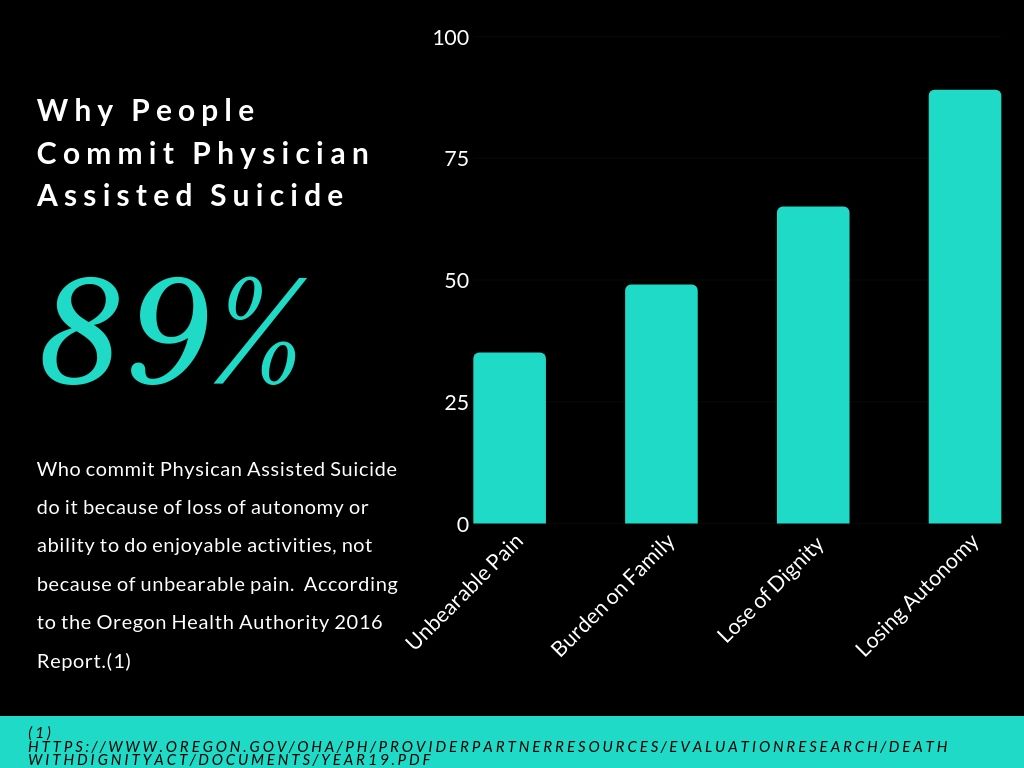
“Untreated pain is not among the top reasons for taking lethal drugs. Per official annual state reports, in 2016, 90% of Oregon patients seeking lethal drugs said they were doing so because they were “less able to engage in activities making life enjoyable” and were “losing autonomy,” and 49% cited being a “burden” on family, friends or caregivers. And in Washington, 52% cited being a “burden” as a reason, while only 35% cited a concern about pain.” (http://www.usccb.org/about/pro-life-activities/respect-life-program/2017/top-reasons-to-oppose-assisted-suicide.cfm) See also Gorsuch, (2006) ,p.123.
Further Reading:
- Neil Gorsuch, “Legislation and the Law of Unintended Consequences,” Chapter 7, The Future of Euthanasia and Assisted Suicide, (Princeton University Press, 2006).
- Ryan T Anderson, “Four Problems with Physician Assisted Suicide,” The Heritage Foundation. Webite [accessed 9/12/2019], https://www.heritage.org/health-care-reform/report/four-problems-physician-assisted-suicide March 30,
- “Some Oregon and Washington State Assisted Suicide Abuses and Complications,” Disability Rights Education & Defense Fund, website [accessed 9/12/2019]
- Richard Doerflinger, M.A., “A Reality Check on Assisted Suicide in Oregon,” [accessed 9/12/2019] April 13, 2017. https://lozierinstitute.org/a-reality-check-on-assisted-suicide-in-oregon/
- “Assisted Suicide in Oregon and Washington. What Safeguard?” USCCB, [accessed 9/12/2019], http://www.usccb.org/issues-and-action/human-life-and-dignity/assisted-suicide/to-live-each-day/upload/Oregon-and-Washing-euthanasia-20131.pdf
- “5 Oregonians to Remember,” http://www.pccef.org/articles/art60.htm
- “Another Case for Nursing Reform,” Editorial, Portland Tribune, July 10, 2007.
- http://www.nrlc.org/archive/news/2008/NRL08/Oregon.html
 Stop Assisted Suicide NY