Do No Harm? Doctors and Assisted Suicide
PAS is fundamentally incompatible with the role of the doctor, which is to provide care for and healing for the patient. The doctor is not a mere “hired syringe” or servant of his patient’s wishes. PAS distorts the role of the physician and risking harming the doctor-patient relationship.
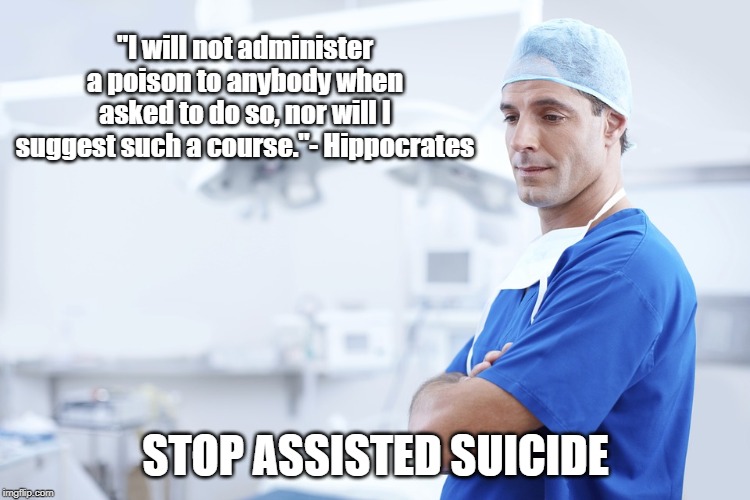
The American Medical Association’s Council on Judicial and Ethical Affairs has repeatedly recommended that the AMA maintain its opposition to PAS (1).
The report is a nuanced one (2) that tries to offer a fair understanding of both sides of the issue, but ultimately strong majorities recommend against changing the AMA’s current opposition to the practice of PAS and euthanasia.
PAS and Euthanasia are not appropriate roles for a doctor
Nothing about the doctor’s role makes him an appropriate choice to kill a person. He is not a hired assassin, nor does the fact that a doctor works in a lab coat with a syringe make PAS and euthanasia medical tasks. They make a doctors engaging in those tasks any different from an assassin who used a gun (with the patient’s consent).
On the contrary, the first role of the doctor is to “do no harm,” to provide medical care for the patient. The doctor is not a mere servant of his client’s wishes (3). If he acts merely as a servant of his client’s wishes to the point of dismissing his first obligation to care for the patient, he no longer acts as a doctor.
A Doctor’s Duty to Care for a Patient
Care for the patient cannot justify PAS or euthanasia. Personal autonomy considerations cannot justify euthanasia and PAS. It is not enough for a doctor to say that he is merely respecting his patient’s (client’s) wish to be killed. For, presumably the doctor would not grant a similar wish from a suicidal teenager, a disgraced businessman, or a failed and suicidal politician.
He would not because of his obligation to care for the patient. Yet, a doctor cannot, as a doctor, kill a patient in the name of caring for a patient. Care considerations cannot justify PAS or euthanasia and they violate the first rule of the doctor to “do no harm.”
The duty to care for the patient means physicians must work to help patient’s manage their pain effectively. Indeed, the AMA report pointed out that “patients and physicians still do not have the conversations they should have about death and dying, and… too few patients are aware of the range of options for end of life care, raising concern that many patients may be led to request assisted suicide because they don’t understand the degree of relief of suffering state of the art palliative care can offer.” (Emphasis mine).
Many patients do not understand how effective palliative care can be. In caring for the patient, the physician’s task is to help the patient manage pain and to understand the wide range of palliative care options available.
PAS and Euthanasia Could Cause People to Lose Trust in Doctors
If people believe that their doctors may see euthanizing them as a viable option, this may cause people to lose trust in their doctor’s, hesitate to check into hospitals, and damage the doctor-patient relationship.
There is evidence this has already happened. A British investigation found that many elderly Dutch patients actually insist on written contracts assuring that they will not be euthanized without their consent before they are willing to check themselves into hospitals (4).
Sources
(2) https://www.ama-assn.org/system/files/2019-05/a19-ceja2.pdf
(3) https://alexanderpruss.blogspot.com/2008/07/euthanasia-patient-autonomy-and.html
(4) From Neil Gorsuch, The Future of Assisted Suicide, (Princeton University Press, 2006), pp.125-126, He is referring to House of Lords Report HL Paper, 21-I of 1993-94 Session at 66.
 Stop Assisted Suicide NY